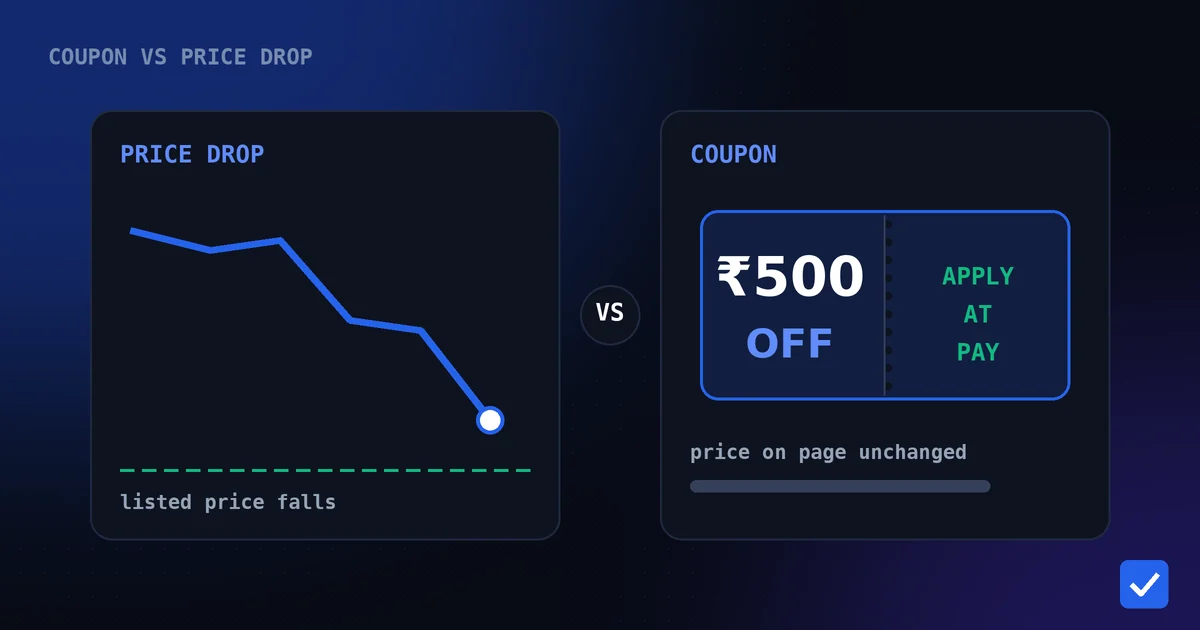
Two products can end up costing you exactly the same, one because the listed price fell and the other because a coupon was waiting on the page. The saving is the same, but the two behave differently: one shows up in the price, the other does not.
Knowing which kind of discount you are looking at helps you compare offers fairly and avoid missing savings that never appear in the listed price.
Key takeaway: compare final payable prices, not listed prices. A coupon changes what you pay without changing what the page shows.
The Main Types of Discount
| Type | What it is | Where you see it |
|---|---|---|
| Price drop | The listed price itself falls. | In the price shown on the product page |
| On-page coupon | A saving you apply on the product page before checkout, as a fixed amount or a percentage. | A separate line or badge near the price |
| Coupon or promo code | A code you type in at checkout. | At checkout, sometimes announced elsewhere |
| Checkout discount | A reduction added automatically at the payment step. | Only at checkout |
| Bank or card offer | A discount tied to a specific payment method, often with limits. | Offer sections and checkout |
Which of these exist on a given product depends on the store, the seller and the time. None of them is guaranteed to be there tomorrow.
How a Price Drop Behaves
A price drop changes the number everyone sees. It is easy to observe, easy to record and easy to compare over time, which is why price history is built from it. It is also usually open to every buyer, with no conditions to meet.
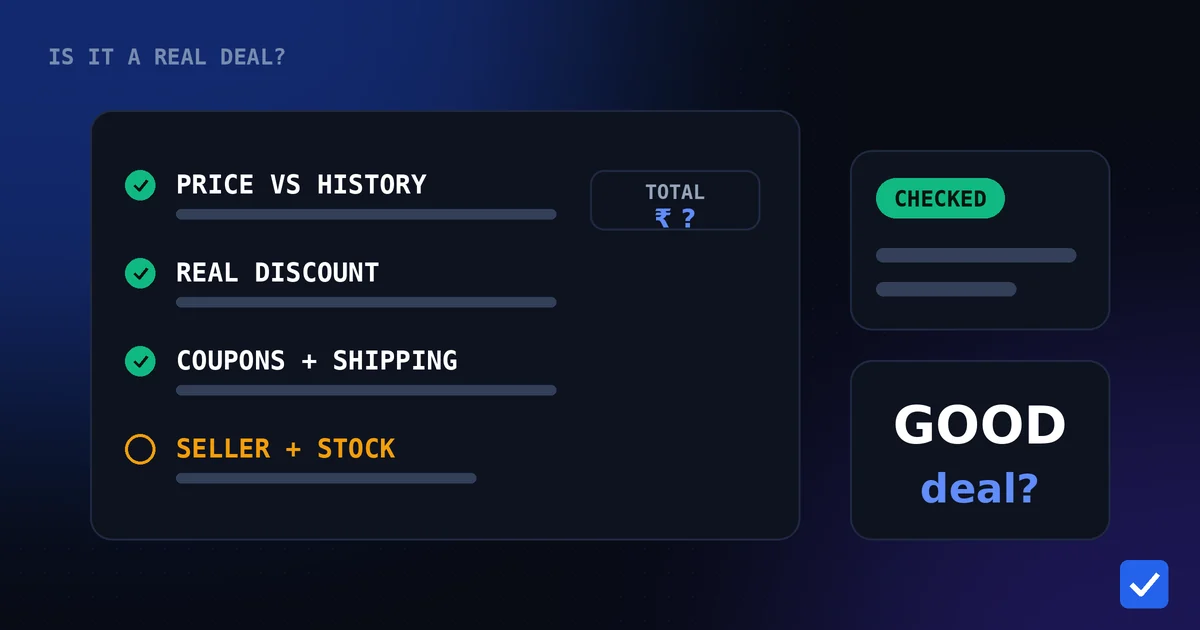
The weakness is that a drop alone does not tell you whether the new price is good. For that, you need context. See how to know if an online deal is actually good.
How a Coupon Behaves
A coupon sits alongside the price. It can appear, change or disappear while the listed price stays exactly the same, and it may be limited by time, by quantity or by terms such as a maximum discount. That makes it easy to miss and easy to assume will still be there later.
Coupons can also be easy to forget about when you set a price target. If you decide you will buy at ₹4,500 and the listing sits at ₹4,999 with a ₹500 coupon, the effective price already meets your number even though the page price has not moved.
Compare Offers by Final Payable Price
Hypothetical example for the same product in two situations:
| Situation 1 | Situation 2 | |
|---|---|---|
| Listed price | ₹4,699 | ₹4,999 |
| Coupon | none | ₹500 off |
| Final payable price | ₹4,699 | ₹4,499 |
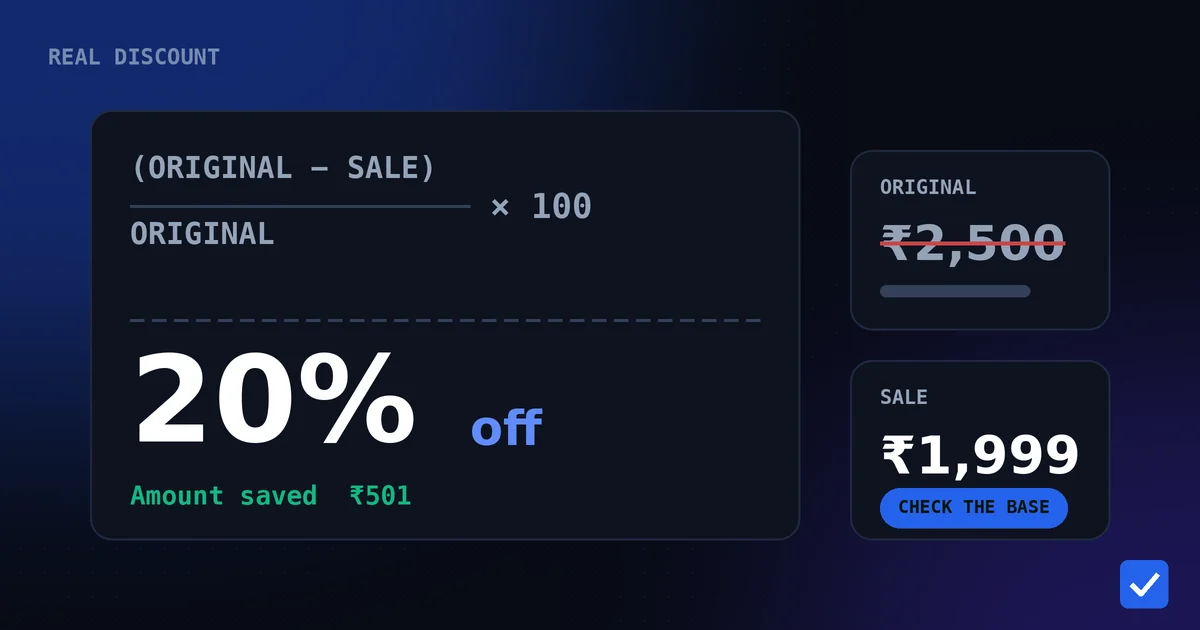
Situation 2 looks more expensive on the page and is actually ₹200 cheaper to buy. The reverse can also happen, for example when a percentage coupon has a low maximum cap. The percentage arithmetic is covered in how to calculate a real discount.
- Note the listed price.
- Subtract any coupon you will actually apply, checking its terms and cap.
- Add delivery or other charges.
- Treat bank offers as optional extras, counted only if you will really use that payment method.
- Compare the result with the product's recent typical price.
When Offers Combine, and When They Do Not
Stores differ on whether discounts stack. Some coupons cannot be combined with certain offers, some bank offers need a minimum spend and some apply only to specific sellers or product variants. The only reliable way to know is to check the final amount at checkout before paying. Do not assume two savings add up. A 20% discount plus a 10% coupon is not 30%.
Tracking Both Kinds of Change
A tracker that only watches the listed price will miss coupons. DealTrackerProBot handles the two separately: price-drop and target-price alerts follow the listed price, and for supported Amazon products it can also send a coupon alert when a coupon appears or changes, when detected. That coverage is Amazon only; Flipkart tracking covers prices, target prices, price history and stock, not coupons. Features can also vary by marketplace and product.
Read Amazon coupon alerts for how coupon alerts work, and Amazon price-drop alerts for the price side. Neither guarantees that every coupon or every drop will be caught.
Which Should You Watch For?
- If you are buying on Amazon: watch both. A coupon can be the entire saving.
- If you are buying on Flipkart: watch the price, target price and stock.
- If you have a firm budget: set a target price and check whether a coupon brings the effective price under it.
- If the product is not urgent: watch for a while and learn how often it changes. See how to set a target price.
Related pages: Coupon Alerts, Price-Drop Alerts, Target Price Alerts, Discount Calculator, Supported Stores