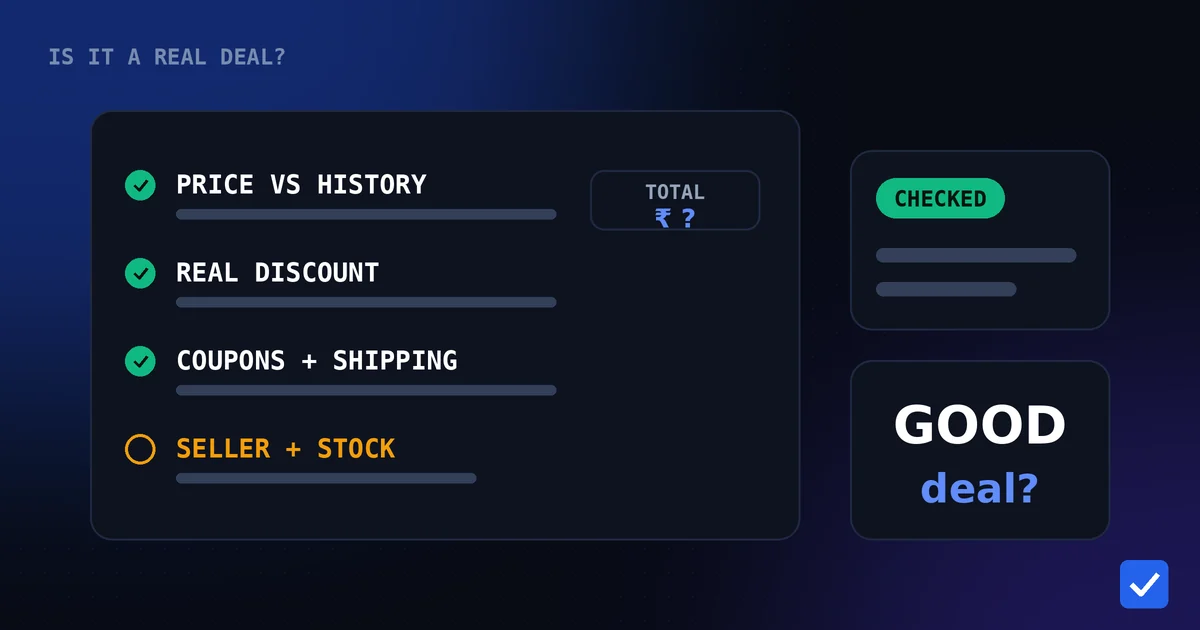
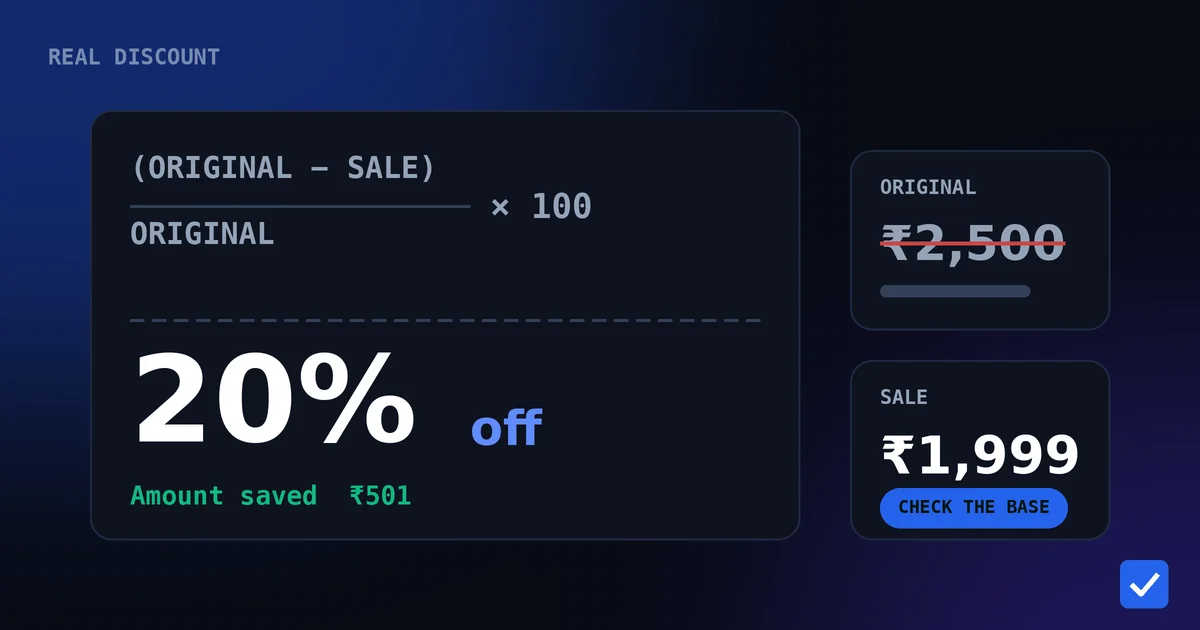
Open any Amazon or Flipkart listing right now and you'll see a red "40% off" badge sitting right next to the price. It looks like a deal. Sometimes it is. Often, it isn't.
Prices on Amazon and Flipkart don't sit still. They move up and down constantly — sometimes several times in a single day — based on demand, competitor pricing, seller stock levels, and automated repricing software that neither shopper nor seller talks about openly. A product that shows "50% off" today might have been sold at that exact same price two weeks ago with no discount badge at all.
Most shoppers have no way of knowing this. They see a price, they see a strikethrough, and they buy. Studies on e-commerce pricing behavior have repeatedly shown that a meaningful share of "discounted" prices during major sales events are within a few percentage points of the item's regular price for the preceding month — the badge changes, the price barely does.
This is exactly why price history exists as a concept, and why more shoppers — especially in India, where Amazon and Flipkart both run aggressive, frequent sales — are starting to check it before clicking "Buy Now."
What Is Price History?
Price history is simply a record of what a product has actually cost over time — daily, weekly, or monthly — plotted so you can see the pattern instead of a single snapshot.
Instead of trusting the number on the page today, you're looking at a timeline: ₹2,999 in March, ₹2,499 in April, briefly ₹1,999 during a flash sale in May, back up to ₹2,799 in June. That timeline tells you something a single price never can — whether today's number is genuinely good, average, or actually worse than what the product sold for a month ago under a "biggest sale of the year" banner.
Think of it the way you'd think about checking a stock's 52-week chart before buying shares, instead of just looking at today's closing price. A single data point tells you almost nothing. A trend tells you whether you're buying at a peak or a genuine low.
For online shopping, this changes the entire decision. Instead of asking "is this a discount?" you start asking "is this the lowest this has been?" — which is a much more useful question, and one that a discount badge alone can never answer honestly.
Current Price vs Historical Price
The current price is a single reading: what a product costs right now. The historical price is the series of readings before it. They answer different questions. The current price tells you what you would pay today, and the historical price tells you whether that is a sensible amount to pay.
For illustration, suppose a pair of headphones costs ₹6,999 today. If it has spent weeks at ₹7,500 and only briefly touched ₹6,800, ₹6,999 is a fair price. If it usually sits at ₹6,200, it isn't. The number only becomes meaningful next to the numbers around it, which is why a discount badge on its own tells you very little.
What Is the Lowest Recorded Price?
The lowest recorded price is the smallest price a tracker has seen for a product. It's a useful reference point with one caveat: it is only as complete as the tracker's record. DealTrackerProBot's history for a product covers the period since you started tracking it, so the lowest recorded price is the lowest the bot has seen in that window, not necessarily the lowest the product has ever sold for.
Used sensibly, it still helps. It gives you a realistic floor when you pick a target price, and it stops you from waiting for a number the product has never come close to. The longer a product has been tracked, the more that floor means, so add products early, well ahead of a purchase or a big sale. The “/price_history” command shows the prices recorded for a tracked product, and every command is listed on the Telegram commands page.
For a step-by-step method to judge a discount using this data, read Amazon price history: is it really a deal?. The price history feature page covers what the bot records, and if you track Flipkart products too, see the Flipkart price tracker guide and the Amazon price tracker guide.
Why Amazon Price History Matters
Amazon's pricing isn't static, and it isn't manual in the way most shoppers assume. Prices are frequently adjusted by algorithms that respond to competitor pricing, inventory levels, and demand signals — sometimes multiple times within 24 hours. A handful of patterns make price history particularly useful on Amazon specifically:
Lightning Deals. These time-boxed deals create urgency ("only 3 hours left," "68% claimed") that pushes people to buy fast without comparing. Price history lets you check, in seconds, whether the "deal" price is actually lower than what the product sold for last month.
Festival sales. The Great Indian Festival, the Great Republic Day Sale, and similar events concentrate huge shopping volume into short windows. Prices are cut aggressively on some items — and quietly nudged up beforehand on others, so the "discount" during the sale looks bigger than it really is. This pattern, sometimes called price anchoring, is exactly what a price history chart exposes.
Seasonal discounts. Electronics often dip in price ahead of a new model launch. Appliances and air conditioners get cheaper outside of summer. Winter wear drops in price as the season ends. None of this is visible from a single listing — it only shows up across months of history.
Daily price fluctuations. Even outside of "sale" periods, prices on popular items can shift by hundreds of rupees within a week due to stock levels or seller competition. A product you're watching casually could become ₹500 cheaper before the weekend, with no announcement at all.
False discounts. This is the one that costs shoppers the most money. A listing shows an inflated "MRP" that few people ever paid, then discounts against that inflated number. The percentage-off badge looks dramatic. The actual price may be identical to, or higher than, last month's. Price history is the only reliable way to catch this.
Why Flipkart Price History Is Equally Important
Flipkart's pricing behavior follows a similar logic to Amazon's, with its own version of the same seasonal pattern: Big Billion Days.
Every year, Flipkart's Big Billion Days sale generates enormous traffic and enormous purchase volume in a short window — and every year, a portion of shoppers later discover that certain items were available at a similar or even lower price a few weeks before the sale started. This isn't necessarily deliberate manipulation on Flipkart's part; sellers set and adjust prices independently on the platform, and pricing during high-traffic events reflects thousands of individual seller decisions, not one central plan. But the effect for the shopper is the same either way — the badge says "biggest discount of the year," and only price history can confirm whether that's actually true for the specific item you want.
Outside of Big Billion Days, Flipkart prices move throughout the year in response to the same forces as Amazon: competing sellers on the same listing, stock availability, and demand around regional festivals. A smartphone might see three or four distinct price points over a single quarter. Without a record of those price points, you're relying entirely on memory — or worse, on the platform's own framing of what counts as a "deal."
Benefits of Tracking Price History
Once you start looking at price history instead of just today's price, a few concrete advantages show up quickly:
- Better buying decisions. You're deciding based on evidence — what a product has actually cost — instead of a badge someone else designed to create urgency.
- Avoiding fake discounts. Inflated "before" prices become obvious the moment you can see what the product actually sold for a few weeks earlier.
- Identifying the true lowest price. You can see the actual floor a product has hit, so you know what a genuinely excellent price looks like versus an average one.
- Timing your purchase. If history shows a product reliably drops during a specific week or event, you can choose to wait instead of buying at a mediocre "discount."
- Comparing seasonal trends. Multi-month history shows you whether a category (electronics, appliances, fashion) has predictable dips, so you can plan bigger purchases around them instead of guessing.
How Price Drop Alerts Work
Price history tells you what has happened. Price drop alerts tell you the moment something changes — which matters because most people don't have time to manually check ten product pages every day.
The mechanism is straightforward:
Target prices. You set the number you're actually willing to pay for a specific product — say, ₹1,999 for a pair of headphones currently listed at ₹2,499. This becomes the threshold the system watches for.
Automatic monitoring. Instead of you reopening the product page repeatedly, a tracking system checks the price on a regular schedule in the background, comparing the current price against your target and against the previous check.
Telegram notifications. The moment the price reaches or drops below your target — or simply drops at all, if you haven't set a target — you get a message. Not an email buried under fifty others, not a push notification you'll swipe away without reading, but a direct Telegram message you'll actually see.
Saving time. The entire point is removing the manual work. You check a product once, set what you'd pay, and let the monitoring happen without you thinking about it again until it's actually time to buy.
Price History vs Price Drop Alerts
These two tools solve different problems, and understanding the difference changes how you use them.
Price history is diagnostic. It answers "is this actually a good price, right now, compared to the past?" You use it at the moment of decision — right before you're about to buy — to confirm whether today's number holds up against the last one, two, or three months.
Price drop alerts are proactive. They answer "let me know the moment this becomes a good price," so you don't have to keep checking manually. You use this when you're not ready to buy today, but you want to be notified the instant the price moves in your favor.
Here's where it gets useful: using both together is genuinely the ideal approach. Check the price history first to understand what a fair price actually looks like for this specific product — is ₹1,999 a good target, or has it only ever dropped to ₹2,200? Then set a target price alert based on that real data, instead of guessing a number that might never be hit, or setting one so high you overpay the moment it's reached.
Price history without alerts means manually rechecking forever. Alerts without price history mean you might set a target that's not actually a good deal. Together, they cover both the "what's realistic" question and the "tell me when it happens" problem.
How DealTrackerProBot Helps
This is exactly the gap DealTrackerProBot was built to close — a Telegram bot that tracks Amazon and Flipkart products for you and tells you when something worth knowing about happens.
Here's what it actually does today:
- Amazon support — track any Amazon product by sending its link directly in a Telegram chat.
- Flipkart support — the same tracking works for Flipkart listings.
- Price history — see how a tracked product's price has moved since you started watching it, so you can judge whether today's price is genuinely good.
- Price drop alerts — get notified automatically the moment a tracked product's price falls.
- Coupon alerts — get notified when a coupon or instant discount becomes available on a tracked Amazon product.
- Back-in-stock alerts — if a product goes out of stock, you're notified the moment it becomes available again, instead of refreshing the page hoping to catch it.
- Target price tracking — set the exact price you're willing to pay, and only get alerted once the product actually reaches it.
- Telegram notifications — every alert arrives as a normal Telegram message, in the same chat where you added the product, with nothing else to check or install.
There's no app to download and no account to create beyond your existing Telegram account. You open the bot, send a product link, and it takes over the watching from there.
Tips for Saving More Money While Shopping Online
A few habits make a bigger difference than most shoppers expect:
Track prices before a sale starts, not during it. If you already know you want something for an upcoming festival sale, start watching it two to three weeks ahead. That's the only way to know if the "sale price" is actually lower than what it cost before the sale was announced.
Don't trust every discount badge at face value. A big percentage-off number is designed to create urgency. It says nothing about whether the current price beats last month's price. Treat it as a marketing element, not a fact.
Use target prices instead of checking manually. Decide what you'd actually pay, set that as your target, and let monitoring do the checking. This alone eliminates the daily habit of reopening the same product page out of anxiety that you'll miss a drop.
Check price history before every big purchase. For anything over a few thousand rupees, a minute spent looking at the last month or two of pricing can save you from buying right before a bigger drop.
Watch for coupons separately from the listed price. Some of the best effective discounts come from stackable coupons rather than the sticker price — and these are easy to miss if you're only glancing at the product page once.
Avoid impulse purchases during flash sales. Countdown timers and "X% claimed" messages are built to short-circuit exactly the kind of comparison this article is describing. If a deal is genuinely good, it'll still be good in the ten minutes it takes to check its price history.
Conclusion
Discount badges are designed to create urgency. Price history is designed to tell you the truth. Once you get into the habit of checking how a product's price has actually moved — instead of trusting the number and the percentage-off badge on the page in front of you — you stop overpaying for things that only look like deals.
The easiest way to build that habit without doing the checking yourself is to let something else watch the price for you. Open DealTrackerProBot on Telegram, send it the Amazon or Flipkart product you're considering, and you'll have price history, price drop alerts, coupon alerts, and back-in-stock alerts running in the background from that point on — no more guessing whether today's price is actually worth it.
Related pages: Pricing, Supported Stores, Telegram Commands, About, Contact, Home, Price History, Amazon Price Tracker, Flipkart Price Tracker, Features, FAQ